Related Links

  • Websense
  • Elsevier Ltd is not responsible for the content of external websites.

Related Stories

  • Search for security
    With more than 30 000 web pages being infected every day, search engine results could increasingly lead to malware infection. Kari Larsen asks what the search engines are doing to mitigate security threats, and how users can protect themselves.
  • CeBIT: Kaspersky warns over highly intelligent smartphone malware
    Last week saw the giant CeBIT Computer Fair taking place in Hannover, Germany, and German newspaper Bild published an interesting interview with Marco Preuss, a security analyst with Kaspersky Lab, in which he warns of the increasing sophistication of mobile phone malware.
  • What’s in store for 2010?
    The Noughties are behind us now, but memories of a decade of data breaches will continue to haunt the infosec professional. If only there was a way of knowing what the threat landscape would look like in the months to come. Well you’re in luck as Davey Winder has dusted off the crystal ball and spoken to a broad church of infosec professionals to get some informed predictions for 2010
  • Kaspersky Lab predicts file-sharing threats to rise in 2010
    In its year-end forecast of security threats for the coming year, Kaspersky Lab is predicting a shift of emphasis from attacks via websites and applications software attacks over towards file-sharing networks in 2010.
  • Online Monopoly gamers targeted via social networking spam
    Websense Security Labs has found a spam operation targeting players of the old game favourite, Monopoly, via social networking methods.

News

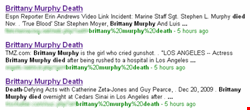
‘Brittany Murphy death’ searches return rogue anti-virus

22 December 2009

Websense Security Labs’s ThreatSeeker Network has discovered that Google top searches on ‘Brittany Murphy death’ returns rogue anti-virus websites.

The Hollywood actress Brittany Murphy died suddenly during the weekend, causing many to search for more news on what happened.

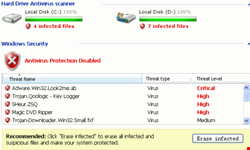
However, when searching for ‘Brittany Murphy death’ on for example Google, users can be redirected to malicious domains offering rogue anti-virus software if they click the matches.

The malicious domains try to convince people that they are real anti-virus software websites, so that people will download and execute malware.

“There are now a lot of variants available, typically named install.exe, and at the moment it seems they haven't attracted much attention from AV companies”, Websense said in its security alert.


This article is featured in:
Malware and Hardware Security Public Sector


Comment on this article

You must be registered and logged in to leave a comment about this article.