Share

Related Links

Related Stories

  • Beware of bogus online offers bearing a free iPad
    Bogus offers for free iPads pose one of the most pernicious threats to online shoppers this holiday season, noted Sam Masiello, director of threat management at McAfee.
  • Zero Day of the Dead
    The data load that has accompanied the globalization of trade would make even Atlas stagger. And that’s without the added burden of counter-terrorisAs you read this, zombie programs are flitting across the internet like a pestilence to infect and drain the life from innocent computer systems. Yet, for all the aggravation and grief they cause, you may never know you are part of a global invasion of the system snatchers, says William Knight. Unless…
  • Fuzzy definitions delay cloud-based security as a service adoption
    The lack of clear definitions for cloud-based security as a service (SecaaS) has caused market confusion and has led to slow SecaaS adoption, according to the Cloud Security Alliance (CSA).
  • Comment: The Seven Habits of Highly Infected People, and Your Security
    Modeled after the popular self-help book, this article by NaviSite’s chief security officer, Allen Allison, discusses how to eliminate the most common and easiest to avoid habits that introduce security risks and governance violations that can imperil an organization’s sensitive data.
  • Spammers moving to social networks and mobile channels
    With global spam levels going down over Christmas and, then returning in recent days, anti-spam specialist Cloudmark says that its research suggests that spammers are actually moving away from traditional email spam channels and over to social networks and mobile email to ply their trade.

Top 5 Stories

News

Phishing rose dramatically in run up to Christmas

31 December 2009

The number of phishing attacks “rose dramatically in the run up to Christmas”, according to managed security services company Network Box.

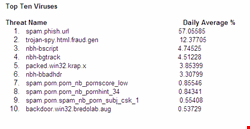
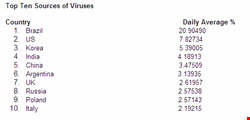
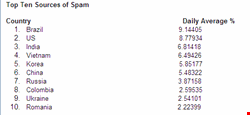
Over 57% of all threats were phishing attacks in December, compared to 28.3% in November, Network Box said. Brazil was the top source of viruses and spam accounting for 20.9% of all viruses and 9.1% of all spam – a significant rise from November’s 14% and 8%, respectively.

India is rising in the threat landscape being the source of 6.8% of all spam coming from the sub-continent compared to 4.2% in November, Network Box said. The country was responsible for 4.1% of all viruses in November.

Simon Heron, security analyst at Network Box, said: “The run up to Christmas is traditionally a time for hackers to strike the vulnerable. A higher proportion of shopping is done online, with more money spent than at any other time of year.

“Christmas offers rich pickings for phishers. This is likely to continue through the sales in January, and we urge online bargain hunters to be vigilant.”

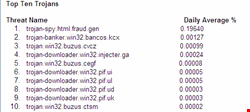
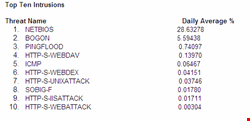
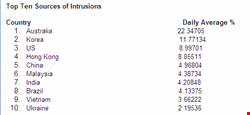
Please see images on the right for further statistics on internet threats in December 2009.

This article is featured in:
Internet and Network Security • Malware and Hardware Security


Comment on this article

You must be registered and logged in to leave a comment about this article.