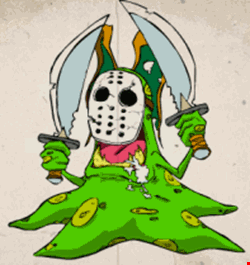
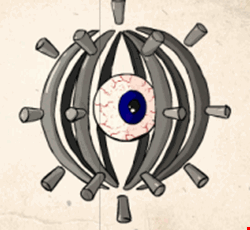
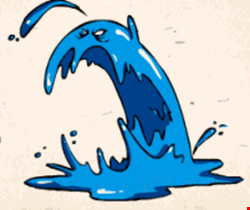
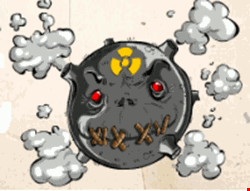
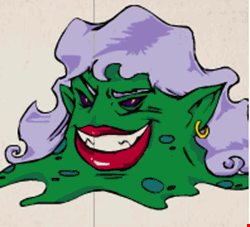
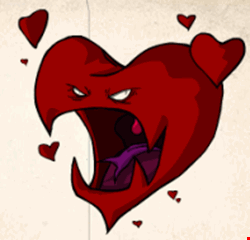
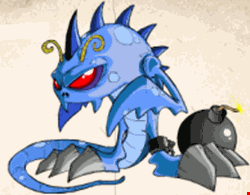
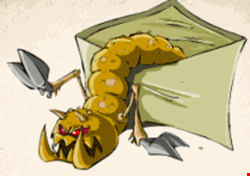
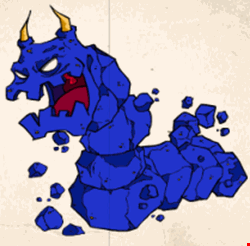
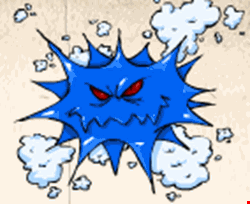

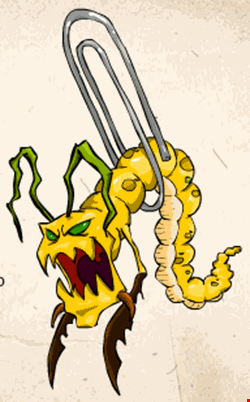
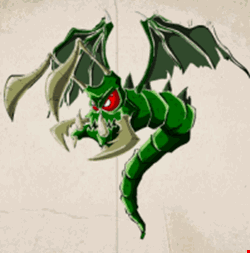
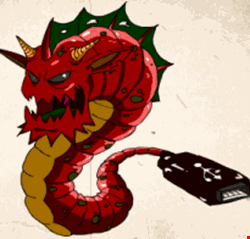
PandaLabs has also given the infamous viruses faces – please see images on the right hand side.
Friday 13 or Jerusalem
Created in Israel in 1988 and first reported in Jerusalem, it supposedly commemorated the 40th anniversary of Israel. Whenever the date was Friday 13, it would delete all programs run on an infected computer.
Barrotes
The first well-known Spanish virus appeared in 1993. Once on the computer, it would remain hidden until 5 January, when it would activate displaying just a series of bars on the monitor.
Cascade or Falling Letters
Created in Germany in 1997. Whenever it infected a computer, it would make the letters on the screen fall in a cascade.
CIH or Chernobyl
This virus was produced in Taiwan in 1998, and took just one week to propagate and infect thousands of computers.
Melissa
First appeared on 26 March 1999 in the USA. This ultra-smart malicious code used social engineering to spread, with a message that read “Here is that document you asked for… don’t show anyone else ;-)”.
ILoveYou or Loveletter
So famous, it hardly needs introduction. This romantic virus emerged from the Philippines in 2000. With the subject ‘ILoveYou’ it infected millions of computers around the world and even organizations like the Pentagon.
Klez
Created in 2001 in Germany, it only infected computers on the 13th of odd months.
Nimda
The name is basically ‘admin’ spelled backwards, as it was able to create administrator privileges on infected computers. It originated in China on 18 September, 2001.
SQLSlammer
This was another major headache for companies. It first appeared on 25 January, 2003, and affected more than half a million servers in just a few days.
Blaster
This virus, created in the USA on 11 August, 2003, contained a message in its code: “I just want to say love you san!!” (We still don't know who ‘San’ is), and “Billy gates, why do you make this possible? Stop making money and fix your software”.
Sobig
This German virus was famous in the summer of 2003. The F variant was the most damaging, it attacked on 19 August of the same year and generated more than one million copies of itself.
Bagle
This emerged on 18 January, 2004, and has been one of the most prolific viruses with respect to the number of variants.
Netsky
This worm also came from Germany in 2004 and exploited vulnerabilities in Internet Explorer. Its creator was also responsible for the notorious Sasser virus.
Conficker
Last on the list and most recent, it appeared in November 2008. Oddly enough, if your keyboard is configured in Ukrainian, it won't affect you…