Single sign-on (SSO) is a foundational component of modern identity architecture, simplifying access for users while allowing security teams to apply consistent controls across applications. When implemented effectively, SSO reduces password sprawl and improves authentication consistency, but the same centralization can amplify risk if a single identity provider account is compromised.
In environments where Active Directory underpins SSO authentication, the strength of domain credentials directly affects the security of every connected application. Attackers are well aware of this dependency and frequently target Active Directory and domain user accounts as a more efficient path to broad access than attacking SSO technologies directly.
Where SSO Implementations Most Often Break Down
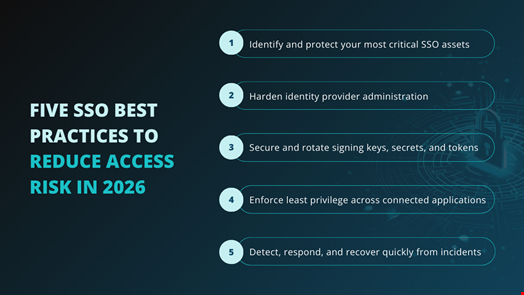
The following five best practices reflect the most common SSO failure points and outline how organizations can reduce identity risk in 2026.
1. Identify And Protect Your Most Critical SSO Assets
Some identities and secrets effectively govern access to the entire SSO environment and should be protected accordingly. These include identity provider administrator accounts, signing certificates and cryptographic keys, OAuth secrets and application credentials, and consent grants or delegated permissions.
A compromise of any one of these assets can allow attackers to impersonate users, escalate privileges, or move laterally across the identity platform. Securing them with elevated controls is essential to reducing the impact of an SSO compromise.
2. Harden Identity Provider Administration
The system that governs authentication for every connected application requires stronger protection than standard user accounts. Administrative privileges should never reside on day-to-day user identities. Separate, purpose-built administrator accounts reduce the risk that malware or session theft on a regular workstation leads directly to privileged compromise.
Privileged accounts should use phishing-resistant multi-factor authentication, such as hardware security keys or platform authenticators. Identity administration should also be restricted to hardened devices that do not allow general web browsing or email access.
Standing administrative privileges increase risk, so elevated access should be granted only when required. Scope privileges to a specific task and time window and automatically revoke them once the activity is complete. For high-impact actions, requiring approval from multiple administrators provides an additional safeguard.
As SSO environments evolve, organizations are extending these controls beyond user identity alone. Access increasingly accounts for both who is authenticating and the security posture of the device they are using, recognizing that identity is now inseparable from endpoint security.
Tools like Specops Secure Password Auditor can help security teams, to quickly identify weak, reused, or compromised passwords on administrative accounts and prioritize remediation before those credentials are exploited.
3. Secure and Rotate Signing Keys, Secrets and Tokens
Signing keys and secrets are critical SSO assets; they should never be stored in source code repositories, configuration files, or unencrypted local storage. Instead, organizations should use centralized key and secrets management systems, whether hardware-backed or cloud-native, that enforce access controls and audit logging.
Operational realities often push manual key rotation down the priority list, leaving credentials in place far longer than intended. Automating rotation on a defined schedule limits the damage caused by undetected compromise. Many organizations rotate signing certificates quarterly and OAuth secrets more frequently.
4. Enforce Least Privilege Across Connected Applications
OAuth scopes and Security Assertion Markup Language (SAML) attributes define what data applications can access, but default configurations often grant excessive permissions for convenience, expanding the blast radius when an account is compromised. Enforcing least privilege helps contain identity-based incidents.
This is particularly crucial for third-party applications, where permissions should be reviewed regularly to identify excessive or suspicious access. For employee access, tying provisioning and deprovisioning to lifecycle events through automated workflows ensures access is granted when needed and promptly revoked as roles change or employment ends.
5. Detect, Respond and Recover Quickly from Incidents
The speed at which suspicious activity is detected and contained often determines the impact of an incident. Logging identity provider configuration changes and routing them to a SIEM allows security teams to correlate identity events with activity elsewhere in the environment.
Security teams should also monitor authentication and token issuance patterns to identify anomalies that may indicate compromise. When suspicious activity is detected, immediately revoking sessions and tokens is critical to prevent attackers from expanding access.
Because authentication is centralized, resilience planning is essential. Maintaining break-glass accounts in a secure password vault, developing tested recovery runbooks, and designing for high availability through redundancy and failover all help ensure identity incidents do not escalate into prolonged outages.
Putting Effective SSO Security into Practice in 2026
Looking ahead, SSO security will continue to evolve toward risk-based access decisions that adapt in real time to changes in user behavior, device health, and session context. Until those models are universally adopted, the security of SSO environments still depends heavily on the strength of domain credentials.
Built-in Active Directory password policies and native SSO protections offer only limited resistance to modern credential-based attacks. Specialized solutions like Specops Password Policy strengthen the authentication layer SSO depends on by extending Active Directory Group Policy with more advanced controls. This includes blocking compromised passwords, preventing incremental or partial password reuse, and enforcing stronger passphrase-based policies without changing existing identity architecture.
Continuous breached password protection helps identify exposed credentials early and remediate them before they can be reused across SSO-connected systems.
To extend that protection, Specops Secure Access applies multifactor and biometric authentication alongside device trust signals to SAML and OIDC-based applications, including those federated through third-party identity providers.
To learn more about how Specops Password Policy and Specops Secure Access can help strengthen the security of your SSO environment, speak to one of our experts today.