Share

Related Links

  • Websense
  • Elsevier Ltd is not responsible for the content of external websites.

Related Stories

  • The art of social engineering
    Social engineering is not new and it’s here to stay. Kevin Townsend looks at how social networking is a social engineer’s best friend and asks what we can do to protect ourselves from this very real – and very personal – threat
  • US standards drive Canadian information security
    An absence of legislation and the presence of the laissez-faire attitude has resulted in Canada being rather lax when it comes to information security compliance. Robin Arnfield looks at how US standards are driving the Canadian information security marketplace
  • US standards drive Canadian information security
    An absence of legislation and the presence of the laissez-faire attitude has resulted in Canada being rather lax when it comes to information security compliance. Robin Arnfield looks at how US standards are driving the Canadian information security marketplace
  • Spear phishing: more effective when it uses social engineering
    Spear phishing may be something of a buzzword in the latest IT security forums, but Solera Networks' director of threat research says that the targeted attack technique can be highly effective if it harnesses the power of social networking.
  • I'll sue you for spamming me (but I'll also quietly infect your computer) scam revealed
    Security training firm KnowBe4 says it is has spotted a new social engineering scam appearing in internet users' mailboxes – the attack tries to scare recipients into opening the infected attachment by threatening to sue them for spamming.

Top 5 Stories

News

Online Monopoly gamers targeted via social networking spam

24 September 2009

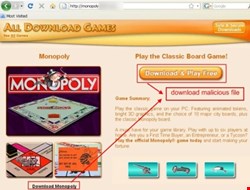
Websense Security Labs has found a spam operation targeting players of the old game favourite, Monopoly, via social networking methods.

Websense’s email honeypot technique detected over 30 000 Monopoly spam messages on 21 September alone. By exploiting its popularity, social networking techniques are being employed to 'invite' users to play the online board game. It then provides a link to the fake Monopoly game download site, which in fact downloads malicious software such as Trojans onto the PC of the unsuspecting user.

Carl Leonard, security research manager of Websense commented: “[Social networking] has revolutionised our entertainment experiences, but because of the very real risk of malicious software, it’s crucial that people have a security solution that can protect both proactively and in real-time. You might opt to ‘take a chance’ on the Monopoly board - but you wouldn’t want to with your security.”

As one of the most popular games across the world, Monopoly is currently the most commercially-successful board game in history, with 485 million players worldwide. More recently, fans of the much-loved game have begun to play it online regularly, including the large scale Monopoly world championships that take place every four years.

This article is featured in:
Application Security • Internet and Network Security • Malware and Hardware Security


Comment on this article

You must be registered and logged in to leave a comment about this article.