
For most security teams, quantum computing has lived comfortably in the "future threats” column. That future is now fast approaching and the vendors that protect today's networks will need to prove they can protect tomorrow's too.
The potential deadline for Q-Day, the hypothetical future moment when quantum computers become powerful enough to break standard public-key cryptography, including RSA and elliptic-curve (ECC) algorithms, has been moved up from 2035 to potentially happening by 2030.
This makes it more urgent for organizations to transition from the current, potentially vulnerable, cryptographic algorithms we use today to encrypt all digital communications and authentication certificates to ones that are certified robust against quantum-powered attacks.
One of the main threats is called ‘harvest now, decrypt later’ (HNDL) and refers to attackers collecting valuable data (code, personally identifiable information…) in an encrypted form now in order to decrypt it with quantum compute when it is available.
Governments are now stepping up post-quantum cryptography (PQC) migration mandates timeline to ensure their most critical organizations are using ‘quantum safe’ encryption algorithms – some of which (ML-KEM, ML-DSA and HLS-DSA) have been standardized by the US National Institute of Technology and Standards (NIST) in August 2024.
In the US, the Trump administration signed two executive orders relating to quantum computing (EO 14412 and EO 14413) on June 22 as well as a memorandum from the Office of Management and Budget (OMB) to the heads of executive departments and agencies two days later.
Among the requirements, the US government asked all federal agencies to complete their PQC migration by 2030 or 2031 at the latest depending on use cases.
Meanwhile, France’s national cybersecurity agency (ANSSI) will stop vetting products that lack quantum-safe encryption starting in 2027, with post-quantum security to become a mandatory feature in the procurement of some security products by 2030.
An ANSSI spokesperson told Infosecurity the move applies to products and services qualified by the agency, which today totals around 90.
“The 2027 date is not a deadline, but a key milestone to ensure that trusted solutions will be available by 2030,” the ANSSI spokesperson confirmed.
Other countries, such as Canada, Australia, Japan, and the UK, follow similar timelines, with 2035 as a target for full PQC transition of government systems and 2028 or 2030 as milestones for quantum-safe critical systems.
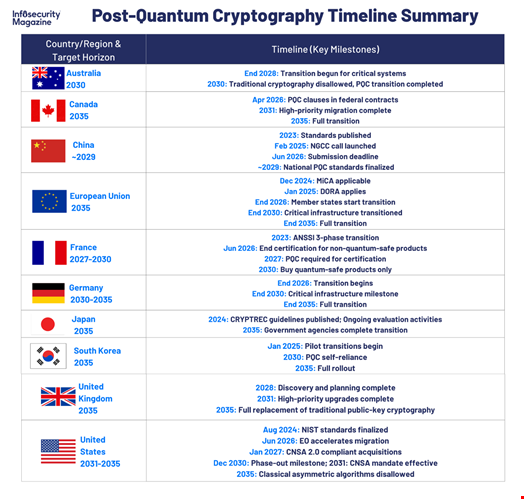
While many of these mandates are focused on government and critical infrastructure organizations, they generally come with a push for other sectors to follow suit and set a roadmap for PQC migration. They also provide guidelines on how to achieve PQC migration and how to deploy cryptographic bills of materials (CBOMs) to prove it.
Yet, if organizations migrate to quantum-safe encryption while the vendors securing their networks don't, they'll have effectively reinforced the front door while leaving the window wide open for attackers to climb through.
Major Tech Firms Publish PQC Roadmaps
Large tech firms, including Cloudflare, Google and Microsoft, have set a 2029 deadline for full PQC migration. Meanwhile, Apple, AWS, IBM and Meta, have officially started rolling out NIST-approved PQC algorithms into their products.
However, some experts are not convinced by some of these timelines and claims. Gregory Carpenter, principal partner at cybersecurity consultancy CW-Pensec, told Infosecurity that several large organizations are doing more ‘quantum signalling’ than actual PQC implementations.
How Cybersecurity Vendors Prepare for PQC
Beyond the biggest tech companies, it is not always easy to gauge the level of quantum readiness of IT providers – especially cybersecurity vendors, who are helping organizations secure their systems.
While many of them tout their capacity to integrate AI capabilities into products and services, with AI appearing on almost every marketing brochure and across all booths at every cyber trade show, what they do to make their product ‘quantum-safe’ is more difficult to assess.
Thibaud Ecarot, PQC engineer and associate professor at the University of Sherbrooke, in Canada, said IT vendors have still very little incentives to promote quantum-safe products and services today.
“They generally don’t see PQC as a competitive advantage at this point,” he said a few days after attending the Quantum Safe Cryptography Conference 2026 in June 2026, an event hosted in Ottawa by European standards body ETSI and the Institute for Quantum Computing (IQC) to address urgent global strategies for PQC migration.
Patricia Titus, field CISO at Abnormal AI, added, “Vendor communities react to customer requests. So, if the customers are not requesting it, vendors are going to put [PQC migration] on the backburner.”
Carpenter said his experience showed that, for now, even financial organizations, which he described as the most advanced in PQC migration, do not require their vendors to implement it.
However, Cloudflare’s Westerbaan said recent procurement mandates, especially in the US, may help accelerate the migration, even for service providers.
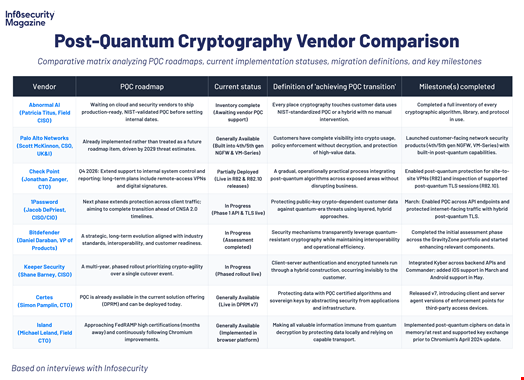
In a bid to examine how vendors are integrating NIST-approved algorithms like ML-KEM and ML-DSA into their roadmaps, Infosecurity has reached out to over a dozen cybersecurity providers.
While some have already integrated PQC into production environments, others are executing multi-year phased rollouts or assessing cryptographic inventories. Their varying approaches highlight distinct operational priorities across network security, identity management and cloud ecosystems.
Early Movers Shipping Immediate PQC Availability
Some cybersecurity vendors are already well underway on their PQC transition journeys, with quantum-resistant features now being embedded into network security, data protection and browser security offerings.
Speaking to Infosecurity, Bas Westerbaan, principal research engineer at Cloudflare, said the company has already completed the PQC migration within its internal systems when PQC algorithms are available. The rest of Cloudflare’s PQC roadmap can now be divided into three tracks:
- Standard cryptography deployment: Leveraging existing teams and processes to migrate straightforward use cases like TLS connections, with training and preparation of necessary libraries and guides
- Custom and complex cases: Identifying and addressing hard cases involving custom protocols, custom cryptography, or hardware dependencies through surveys and manual efforts by engineering teams
- Vendor and supply chain readiness: Ensuring vendor dependencies are accounted for by surveying suppliers on their readiness for PQC and planning for potential impacts of quantum computers on business continuity
Meanwhile, Palo Alto Networks’ customer-facing network security products – including fourth- and fifth-generation next-generation firewalls (NGFWs) and VM-Series – now feature built-in post-quantum capabilities.
The goal, Scott McKinnon, CSO for UK&I at Palo Alto Networks, told Infosecurity, is ensuring "customers have complete visibility into crypto usage, policy enforcement without decryption and protection of high-value data."
Similarly, Simon Pamplin, CTO at data protection provider Certes, emphasized that PQC is "already available in the current solution offering, Data Protection and Risk Mitigation (DPRM), and can be deployed today."
Pamplin stated that DPRM v7 introduces enforcement points designed for third-party access devices, with an overarching transition definition focused on "protecting data with PQC certified algorithms and sovereign keys by abstracting security from applications and infrastructure.”
For browser-based security provider Island, post-quantum readiness is tied to client-side data protection. Michael Leland, Field CTO at Island, explained that the company’s objective centers on making all valuable information immune from quantum decryption by protecting data locally and relying on capable transport.
Leland highlighted that Island implemented post-quantum ciphers for data in memory and at rest, while supporting the key exchange quantum-safe algorithm, ML-Kem, following Chromium's April 2024 updates. Island provides a Chromium-based enterprise browser.
Phased Rollouts, Hybrids and Crypto-Agility
Other vendors are adopting structured, phased migrations, leveraging hybrid cryptographic schemes to avoid single cutover disruptions while maintaining seamless user experiences.
Shane Barney, CISO at Keeper Security, described their strategy as "a multi-year, phased rollout prioritizing crypto-agility over a single cutover event.”
Crypto agility refers to a system's ability to switch, update or replace cryptographic algorithms and parameters quickly without disrupting ongoing operations or requiring major infrastructure redesigns.
Keeper has integrated ML-KEM across backend APIs, Commander, iOS and Android platforms. This, Barney explained, ensures that client-server authentication and encrypted tunnels run through a hybrid construction that occurs "invisibly to the customer.”
1Password is extending protection across client traffic. Jacob DePriest, CISO/CIO said the firm is "aiming to complete transition ahead of Commercial National Security Algorithm Suite 2.0 (CNSA 2.0) timelines."
CNSA 2.0 is the US National Security Agency's (NSA) set of quantum-resistant cryptographic standards designed to protect classified National Security Systems (NSS) against future attacks by quantum computers. Key milestones include the January 1, 2027 procurement gate, software/networking exclusive usage by 2030, and complete migration by 2035.
"There is no standardized PQC algorithm for digital signatures, so no one can migrate this type of encryption."
1Password has already enabled PQC across API endpoints and secured internet-facing traffic with hybrid post-quantum TLS, prioritizing the protection of public-key crypto-dependent customer data against quantum-era threats.
Check Point is following a similar operationally practical trajectory. Jonathan Zanger, the CTO, outlined the company’s approach as "a gradual, operationally practical process integrating post-quantum algorithms across exposed areas without disrupting business".
Having enabled post-quantum protection for site-to-site VPNs and TLS session inspection in recent R82 releases, Check Point's major software release for quantum products and cloud firewall, Zanger indicated that the firm targets the last quarter of 2026 to extend support to internal system control and reporting, with long-term plans encompassing remote-access VPNs and digital signatures.
Assessment, Inventories and Ecosystem Dependencies
For platforms deeply integrated into third-party cloud infrastructure or wide software suites, PQC preparation begins with comprehensive auditing and strategic alignment.
Daniel Daraban, VP of products at Bitdefender, characterized their transition as "a strategic, long-term evolution aligned with industry standards, interoperability and customer readiness".
Bitdefender has completed its initial assessment phase across the GravityZone portfolio, the company’s unified enterprise cybersecurity and extended detection and response (XDR) platform and is actively enhancing relevant components so security mechanisms can "transparently leverage quantum-resistant cryptography.”
For cloud-reliant security providers, migration timelines remain linked to external standardizations.
Abnormal AI’s Titus stated that the organization is "waiting on cloud and security vendors to ship production-ready, NIST-validated PQC before setting internal dates".
Although internal timelines await third-party readiness, Titus confirmed that Abnormal AI has already "completed a full inventory of every cryptographic algorithm, library and protocol in use," ensuring every customer data touchpoint can transition cleanly without manual intervention once vendor support lands.
Future Outlook: Remaining Challenges Toward PQC Migration
When you scratch the surface, it is apparent PQC transition is on the minds of many cybersecurity vendors’ security leaders.
However, the road to full quantum-safe system migration is still long and many challenges remain, for vendors and end-users alike.
First, Ecarot said that a full PQC migration is not possible yet, even for an organization wishing to achieve it, as not all encryption use cases have their PQC algorithms standardized yet.
“For instance, there is no standardized PQC algorithm for digital signatures, so no one can migrate this type of encryption,” he noted.
In July, researchers at Anthropic used their AI frontier model Mythos Preview to deploy a successful attack against HAWK, one of the third-round candidates under consideration by NIST to become a standardized PQC algorithm for digital signatures.
Further, many experts highlighted a major issue with PQC deployment: there is currently no such thing as a common – let alone standardized – definition of what it means to be ‘fully quantum safe.’
“We know which cryptographic algorithms are vulnerable – these are the public-key and asymmetric cryptographic algorithms like RSA and ECC – and which ones aren’t, with symmetric cryptographic algorithms like AES-128 and AES-256 are generally considered robust to quantum attacks,” Cloudflare’s Westerbaan explained.
However, there is no formally accepted threshold of how much encryption must be quantum-safe to claim having achieved the PQC transition.
“Does it mean that every single cryptographic algorithm used within any service, product or environment has been replaced, or just the critical ones or 70% of all systems? It’s not clear,” said Westerbaan.
Additionally, Joe Ghalbouni, a research associate at the EDHEC Quantum Institute, emphasized that vendors will need to both make sure their encryption algorithms are quantum-proof and ensure they keep providing the same level of service.
To ensure the same service-level agreements (SLAs) as before, Westerbaan said vendors will have to deal with hybrid encryption for a while, where current algorithms coexist with quantum-safe ones.
Others, like Ghalbouni, suggested that some hybrid systems could also include quantum key distribution (QKD) infrastructure, a hardware-based approach that uses the principles of quantum physics to exchange encryption keys rather than relying on mathematically hard problems, as PQC algorithms do.
Finally, Ghalbouni and Ecarot highlighted a gap in efficient inventory. The former said organizations lack a vendor-agnostic quantum risk assessment framework, while the latter mentioned a lack of encryption inventory products on the market.
“A lot of existing products on the market provide mere lists of RSA keys, which are not helpful when undertaking a PQC migration,” Ecarot warned.
Infosecurity contacted several other cybersecurity vendors and tech companies for this article, including Google, Microsoft, Rapid7, Proofpoint and Arctic Wolf. Proofpoint declined our request for comments. Google, Microsoft, Rapid7 and Arctic Wolf did not respond by the time of publication.