The 2026 FIFA World Cup is influencing more than conversations, headlines, and viewing habits. It is also shaping password choices.
Users often build passwords around familiar references such as favorite players, clubs and tournament moments. In enterprise environments, especially those built around Active Directory, that familiarity can become a weakness. A password may meet complexity requirements on paper and still be highly predictable in practice.
Recent research from Specops Software highlights the issue clearly. After analyzing more than 6.4 billion compromised passwords, Specops found football-related terms appearing at scale in breached credential data. Player and club names showed up repeatedly, often in formats that still satisfy standard complexity rules. In other words, a password can look compliant and still be easy to predict.
Why Users Choose Football-Related Passwords
Most users are not trying to create weak passwords. They are trying to create passwords they can remember.
That gets harder as the number of credentials grows. Corporate accounts, SaaS apps, VPNs, email and internal systems all add to the load. Even with SSO, exceptions remain, and password fatigue is still a reality.
To cope, users usually do one of two things: rely on a password manager or fall back on personal references that are easier to recall.
Football is a natural fit for that behavior. A favorite player, a club followed since childhood or a memorable final can feel like an easy building block for a password. The same qualities that make those references memorable also make them useful to attackers.
Specops’ analysis of real-world breach data, including the infostealer dataset Alien Txtbase, reflects that pattern.
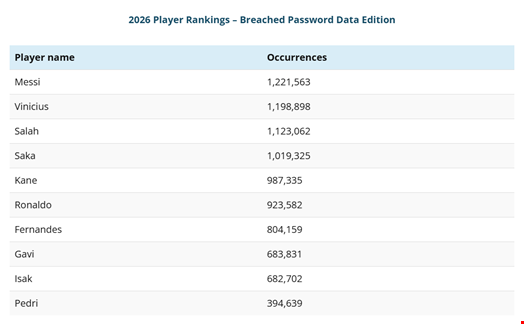
Messi leads the player rankings with more than 1.2 million occurrences. Cristiano Ronaldo follows with about 923,000, a gap of roughly 26%. Other names high on the list include Vinicius, Salah, Saka, Kane and Pedri.
The club rankings tell a similar story. Roma appears more than 5.3 million times, well ahead of Porto, Barcelona and Lyon. Specops suggests that lead likely reflects references to the city of Rome as much as support for the club itself. And this pattern is not unique to football. TV shows, films, celebrities and other cultural references often influence password choices in the same way.
How Attackers Turn These Patterns into Access
A password that is easy to remember is often easy to guess. Attackers use automated tools and custom wordlists built around context, including public events, industry terms and likely user interests.
They then apply predictable changes: adding a year, swapping letters for numbers or symbols, capitalizing the first letter or adding punctuation.
Take Cr7ronaldo@? as an example. It includes uppercase and lowercase letters, numbers and special characters, so many standard policies would allow it. But if an attacker assumes the user follows football, the password becomes much easier to predict than it appears. The same goes for Messi2022!, which follows the familiar [word][year][symbol] pattern still common in leaked credentials.
This kind of predictability supports two common attack methods. In password spraying, attackers test a small set of likely passwords across many accounts while avoiding lockouts. In credential stuffing, a password exposed in a consumer breach can be reused to access a corporate account if the same credentials are used at work.
Why Native AD Policy is Not Enough
It is easy to assume that the password controls built into Active Directory are enough. They remain the foundation of identity security in many Windows environments, but they are limited when it comes to blocking themed or contextually weak passwords.
Group Policy can enforce minimum length, password history, expiration and character-class complexity. But those controls check structure, not meaning. Under that logic, a password like Messi2026! is valid because it contains the required mix of characters. The system does not know that “Messi” appears at scale in real-world password leaks.
Fine-grained password policies add flexibility across user groups, but they do not solve the core problem. Native Active Directory password controls still lack practical ways to block context-specific terms or check new passwords against known breached password datasets.
That leaves organizations with a gap between what a password policy can enforce and what attackers can easily predict.
Blocking Weak Passwords Before They Teach AD
The better approach is to stop weak passwords when a user creates or changes them, directly inside Active Directory.
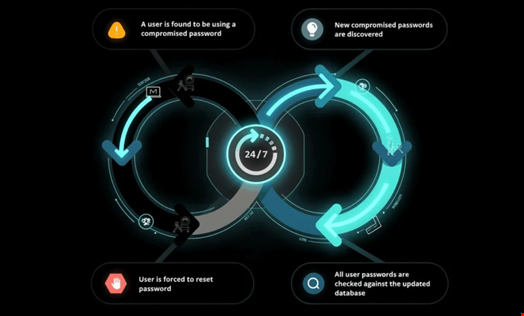
Trying to address them later still helps, but it leaves a window of exposure between password creation and detection. To close that gap, organizations need two things: a custom dictionary to block organization-specific and event-driven terms, including player and club names, and a continuously updated breached password database to reject passwords already known to attackers.
How Specops Strengthens Password Controls in AD
Specops Password Policy extends native Group Policy password controls in Active Directory. It runs on domain controllers and uses GPOs, so organizations can apply different password rules by group or organizational unit without changing their setup.
It also adds the controls that native AD lacks. Administrators can define forbidden terms, block common variations automatically, and support passphrases, making it harder for users to rely on predictable words modified with symbols or numbers.
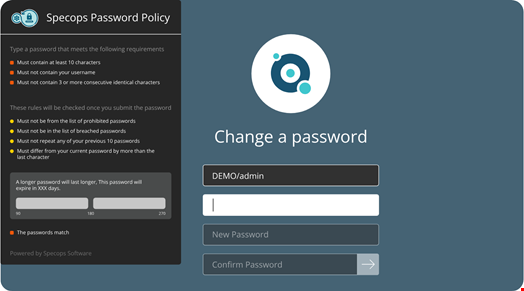
Breached Password Protection checks passwords against a compromised credential database that now exceeds 6.1 billion entries. That database is continuously updated using threat intelligence, honeypots, and leak data, including infostealer-related sources.
For organizations that rely on Active Directory, now is a good time to make sure football-themed passwords do not become a security issue. If you are reviewing your password controls, contact a Specops expert to see how to close the gaps left by native policy.