
A Chinese threat actor has used large language models (LLMs) from Chinese and Western companies to compromise internet-exposed digital infrastructure in Asia.
In particular, they leveraged one of DeepSeek’s AI models, Hermes Agent, an open-source agentic AI framework, to orchestrate the attack via Telegram.
These AI-augmented offensive capabilities “enabled them to dramatically increase the speed and scale of their campaigns,” said Andy Piazza, senior director of threat intelligence within Unit 42, Palo Alto Networks’ research team, in a report published on July 30.
AI Orchestration and Manual Vulnerability Exploitation
The threat actor is a Chinese-speaking individual operating under the aliases ‘knaithe’ and ‘KnYuan’ and based in Zhuhai, China.
Piazza described them as “an opportunistic exploit operator and self-described binary security researcher” based on the actor’s GitHub activity, specifically their maintenance of 1DayNews, an automated vulnerability intelligence pipeline.
They targeted internet-exposed infrastructure by combining autonomous AI-driven enumeration and automated exploitation with the automated and manual exploitation of seven vulnerabilities.
When initial exploitation failed due to the target environment's restrictive configurations, the actor’s Hermes Agent, connected to a DeepSeek AI model, autonomously conducted searches for known critical-severity common vulnerabilities and exposures (CVEs). It initially surveyed 10 product families, scanning GitHub for trending proofs of concept (PoC) exploits and prioritizing vulnerabilities by attack surface.
This research led the agent to pivot to seven higher-value vulnerabilities:
- CVE-2026-33017 (CVSS rating: 9.8): Langflow vulnerability with autonomous exploitation attempt (failed — auto_login disabled)
- CVE-2026-21858 (CVSS rating: 10.0): n8n Workflow Automation vulnerability with autonomous exploitation attempt (failed — auth required)
- CVE-2025-68613 (CVSS rating: 9.9): n8n Workflow Automation vulnerability with autonomous exploitation attempt (failed — auth required)
- CVE-2026-3055 (CVSS rating: 9.8): Citrix NetScaler ADC & Gateway vulnerability with manual active exploitation (data exfiltrated)
- CVE-2026-34486 (CVSS rating: 7.5): Apache Tomcat vulnerability with manual active exploitation (reverse shell attempts)
- CVE-2026-39987 (CVSS rating: 9.8): Marimo Notebook vulnerability with manual active exploitation (command execution confirmed)
- CVE-2026-0300 (CVSS rating: 9.8): PAN-OS User-ID Authentication Portal vulnerability with manual non-functional research PoC cloned (not executed)
- CVE-2026-33824 (CVSS rating: 9.8): Windows IKE Extensions (IKE VPN) vulnerability with manual active exploitation (reverse shell attempts)
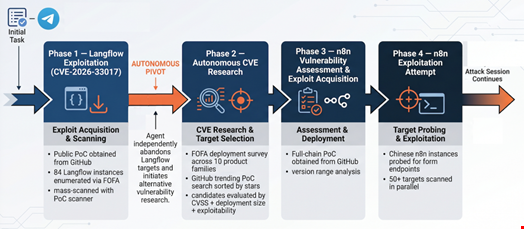
Evidence of Trial and Testing of AI Tools
In parallel with their use of DeepSeek as their autonomous operator platform, the actor configured multiple LLMs, including Chinese ones (Qwen, GLM, Kimi, MiniMax) and limited usage and testing of Western AI tools, like Claude Code for connectivity testing and proxy validation and OpenAI’s Codex on exploit development directories.
“This limited usage is consistent with evaluating the AI-market to identify their preferred tool set,” Piazza wrote.
While the observed campaign had limited impact and did not achieve full compromise of any of the intended targets, the workflow confirms a functional, end-to-end autonomous offensive capability.
The campaign saw targets spanning three countries, including China and Malaysia, and multiple sectors.
According to Piazza, the main takeway from this campaign lies in the trajectory rather than the outcome.
“The actor is actively iterating – refining tool configurations, developing custom skills, establishing proxy infrastructure and executing autonomous attack cycles. The technical barrier to AI-augmented offensive operations is low and continues to decrease,” the researcher added.
Image credits: PJ McDonnell / ImageFlow / Shutterstock.com
Read now: AI-powered Cyber-Attacks Up Significantly in the Last Year, Warns CrowdStrike