
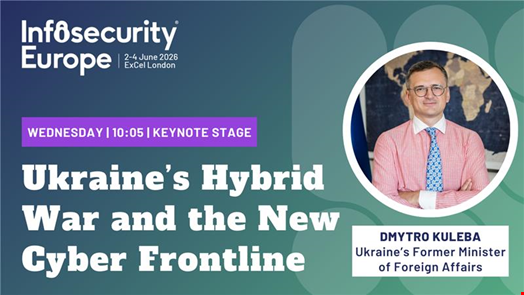
Infosecurity Europe has announced former Ukrainian Minister of Foreign Affairs, Dr. Dmytro Kuleba as headline keynote for its 2026 conference program. The event will run from 2–4 June at ExCeL London.
Kuleba will take to the keynote stage on Wednesday, June 3 at 10:05, delivering his talk on ‘Ukraine’s Hybrid War and the New Cyber Frontline.’
Serving as Ukraine’s Minister of Foreign Affairs from 2020 to 2024, Kuleba was a key architect of the nation’s wartime strategy alongside President Volodymyr Zelensky.
During the Infosecurity Europe keynote, Kuleba will share the critical learnings his country gained while under digital siege.
He will detail how Russia coordinated cyber-attacks with kinetic strikes: from the crippling of telecommunications to the weaponization of disinformation. He will explain why Western enterprises are now the primary front line and what their cyber teams must know to survive this new era of "permanent shock."
Rising Tensions Makes Cyber Collaboration Harder Across Europe
This geopolitical focus comes amid Infosecurity Europe’s 2026 Cybersecurity Trends Research which found that over half, 59%, of cybersecurity professionals say geopolitical tensions are making European cyber collaboration harder.
Countries including the UK (62%), France (68%) and Denmark (69%) all report that collaboration is becoming more difficult. Just 16% of survey respondents said tensions have had no impact.
Infosecurity Europe’s 2026 Cybersecurity Trends research was conducted by Zing Insights, among 396 cyber security professionals in the UK, France, Germany, Holland, Belgium and Denmark.
The research also revealed a widening split in confidence over European cyber cooperation, with 42% saying their country is doing enough, 43% saying it is not. Majorities in the UK (53%) and Germany (57%) expressed concern that current collaboration models are falling short.
Despite these challenges, the value of collaboration is clear, with 33% citing threat intelligence sharing as the greatest benefit and 27% highlighting stronger cross‑border incident response coordination.
Geopolitics and Cybersecurity Take Centre Stage
On Tuesday June 2 at Infosecurity Europe, Professor at Oxford University’s Blavatnik School of Government and Director of CISO Network at SANS Institute, Ciaran Martin will chair the morning sessions, setting the tone for a program shaped by real-world geopolitical and cyber challenges.
As the founding CEO of the UK’s National Cyber Security Centre (NCSC), Martin led the response to more than 2000 nationally significant cyber-attacks and helped establish the UK as a global leader in cybersecurity.
Further shaping the geopolitical discussion at Infosecurity Europe, a senior representative from the NCSC will deliver a keynote on ‘Cyber Security 2026 - State of the Nation’ on Tuesday, 2 June at 11:05.
The session will outline the UK’s cyber threat landscape, national priorities and what they mean for you; with an outline on how the threat picture is shifting, where the NCSC is focusing its efforts in the coming years, and how government, industry and critical national infrastructure can work together to build resilience at scale.
Attendees will hear what emerging regulation and guidance mean for security professionals, and leave with clear, practical steps security leaders can take to align with the UK’s national cyber strategy.
Registration
Registration for Infosecurity Europe 2026 open and is free until 5 May, after which entry will cost £49, including access to the exhibition floor and all theatre sessions.