
The number of cybersecurity job adverts that require AI skills have doubled year-over-year across G7 countries, encompassing over a quarter of new roles, according to new research by the Cisco-founded AI Workforce Consortium.
Analysis of data from recruitment firms Cornerstone and Indeed found that 28.5% of cybersecurity job postings between October 2025 to March 2026 required AI skills, up from 14.2% during the same period a year earlier.
It found that an “agentic skill stack” is emerging as a baseline for high-volume cybersecurity roles such as security engineering, cloud security, and detection and response engineering.
The report highlighted the increasing influence that AI is having on cybersecurity jobs, with teams being restructured around new combinations of human and machine effort.
Rather than becoming obsolete, many technical roles, such as security operations center (SOC) analysts, are developing into less technical roles and more “human” in nature, according to the study. This is because AI systems are assuming high volume, repetitive tasks, such as triaging alerts, correlating threat intelligence feeds and executing standard decision-tree workflows.
Technical roles such as security engineers and SOC analysts remain the most in demand cyber positions.
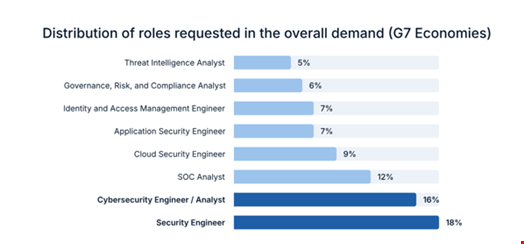
Individual workers in these types of positions have taken on more strategic and oversight functions, such as validating outputs, assessing risk and ensuring decisions are sound.
As a result of this shift, the study highlighted a significant growth in the need for cybersecurity professionals to develop strategic and softer, human skillsets roles in their roles. These include ethical reasoning (up 533% year-over-year), systems thinking (up 251%) and stakeholder engagement (up 125%).
The study was produced by the AI Workforce Consortium, founded in 2024 by Cisco alongside Accenture, Cornerstone, Eightfold AI, Google, IBM, Indeed, Intel, Microsoft and SAP. It combines original research with insights from Consortium members.
AI Increases Barriers to Entry-Level Roles
The report, published on August 20, noted that demand for cybersecurity roles is continuing to rise, up by 9.5% across G7 countries for the six-month period ending in March 2026.
However, there was a significant discrepancy between the volume of senior job postings compared to junior-titled roles, putting the talent pipeline under pressure. While senior cybersecurity postings grew 65% between October 2025 and March 2026, junior roles only rose by 5.9% over the same period.
This “experience gap” can be partly explained by the expectations of security leaders for cybersecurity positions, which are often unattainable for entry-level candidates.
In a May 2026 survey by Cisco, security leaders cited the three competencies that are hardest to find in entry-level candidates as hands-on experience with AI agents (49%), technical cybersecurity depth (48%) and human-centric professional skills (45%).
The authors of the report said the findings demonstrate that there needs to be a fundamental rethink of how the next generation of cyber talent gets built.
“To better prepare students for entry-level roles, we have to rethink what gets taught, and how. That means experiential learning, lab exercises where students audit, validate, and critically evaluate AI agent-generated outputs, not just theory. It also means more internships, apprenticeships, and industry-sponsored projects, giving students real-world experience before they’re on the job,” the report read.