Vulnerabilities found with the help of AI are disproportionately likely to enable remote code execution (RCE), as disclosures and exploitation both accelerated in 2026.
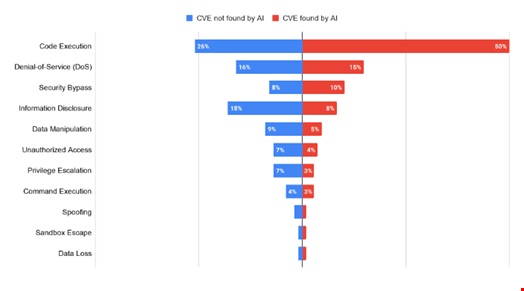
In research published September 30, Google Threat Intelligence Group (GTIG) found that 50% of vulnerabilities it identified as likely AI-discovered resulted in RCE, against 26% of other CVEs.
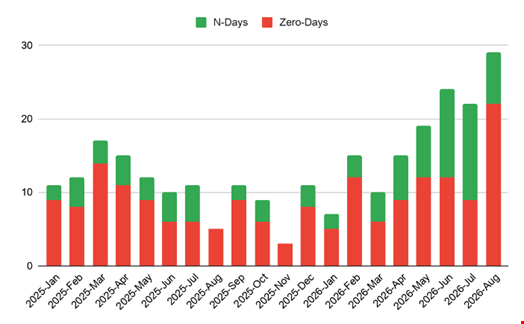
Vulnerability disclosures doubled from 5045 in January 2026 to 10,477 in July, reaching 10,740 in August. Exploited vulnerabilities rose from an average of 10.5 a month in 2025 to 18 a month so far in 2026.
Zero-day exploitation rose only marginally, from eight to 11 a month, although it jumped to 22 in August. GTIG suggested most of the growth came from the rapid weaponization of n-days, possibly aided by AI tools that analyze patches and proof-of-concept code.
AI Discovery Skews Toward Higher-Impact Flaws
Medium-risk flaws accounted for 58% of likely AI-discovered vulnerabilities between January and August 2026, compared with 28% of those not attributed to AI, while low-risk flaws made up 39% and 69%, respectively. The ratings are GTIG's, not CVSS scores.
Google said the distribution likely reflects, in large part, how researchers deploy autonomous agents, pointing them at critical infrastructure rather than running broad scans. It also said public data undercounts AI-discovered vulnerabilities.
The company described confirmed exploitation of AI-discovered flaws as an early indicator rather than an established trend.
It cited CVE-2026-1731, an unauthenticated command injection flaw in BeyondTrust Privileged Remote Access and Remote Support that Hacktron AI discovered autonomously.
One threat cluster exploited it within four days of disclosure, and five more followed within seven days.
Orchestration Tools and Edge Devices Concentrate Risk
GTIG tracked more than 1500 AI-related vulnerabilities disclosed in 2026. Agent orchestration frameworks accounted for 782, while inference and serving infrastructure accounted for 212, nearly a quarter of which involved unauthenticated APIs or server-side request forgery.
Only a handful have been confirmed as exploited, and GTIG has yet to see zero-day exploitation of AI infrastructure.
Exploitation overall remained concentrated at the perimeter: edge and security appliances made up 14% of exploited vulnerabilities in 2026, and over 65% of those edge flaws were rated high or critical risk.
The research follows Citrix's fixes for two exploited NetScaler zero-days, one of which GTIG and Mandiant have tracked in active attacks.
"Given the active exploitation, NetScaler customers should prioritize examining their systems for compromise before upgrading/patching," Charles Carmakal, CTO at Mandiant, wrote on LinkedIn on September 27. "Patching alone may not eradicate the threat actor from your environment."