
As frontier AI models supercharge vulnerability research, open-source security faces an existential challenge: an explosion of AI-generated vulnerability reports, flooding an already understaffed field. Industry leaders are responding with a new generation of security coalitions.
AI-fatigue in the open-source community is not entirely new. Open-source leaders have been complaining about growing AI-assisted security reports since at least the spring of 2025, when AI labs Anthropic and OpenAI launched Claude Code and Codex, respectively.
For instance, Daniel Stenberg, the founder and lead developer of Client URL Request Library (cURL), permanently ended the project’s paid bug bounty program in January 2026 due to an overwhelming flood of low-quality, AI-generated reports.
However, the problem has recently shifted from report quality to report volume.
AI Vulnerability Reports: From Slop to Finding Overload
Christopher ‘CRob’ Robinson, CTO and chief security architect at the Open Source Security Foundation (OpenSSF), says maintainers are no longer simply struggling to sift through poor-quality “AI slop” reports, but are now facing an influx of genuinely relevant vulnerability findings.
Speaking to Infosecurity, Robinson dated the shift to the spring of 2026, when Anthropic launched Claude Mythos Preview through the restricted Glasswing Project, followed by OpenAI’s Trusted Access for Cyber (TAC) and Daybreak programs.
“The frontier AI models improved and their ability to find and fix problems and vulnerabilities got significantly better, too,” Robinson says.
“Now, you see industry people like Stenberg doing 180 degrees on their opinion and starting to recognize the value of AI tools for finding vulnerabilities.”
Read more: What Fronter AI Models Like Mythos and GPT-Cyber Mean for Modern Cybersecurity
Nevertheless, one thing remains true: open-source maintainers continue to be overwhelmed by a vulnerability report overload.
In May 2026, Linux founder Linus Torvalds said the Linux kernel's private security mailing list had become “almost entirely unmanageable” because different researchers were using the same AI tools and reporting the same vulnerabilities.
In August, the team behind OpenSSL told Infosecurity their security inbox had gone from around nine monthly reports and enquiries to roughly 70.
The US government noticed this shift and in July launched Gold Eagle, a program intended to drive faster exploit detection and remediation.
The White House described it as “a coordinated system to receive and patch cyber vulnerabilities at a speed and scale never seen before using the existing authorities and resources of the federal government.”
The end-product of the Gold Eagle program, which should involve the Cybersecurity and Infrastructure Security Agency (CISA), the Treasury, the Department of Defense (DoD) as well as private sector partners, will take the form of what the Trump administration called “a vulnerability clearinghouse” for open-source software and American critical infrastructure companies.
"Banks contacted us, saying they have access to frontier AI models that allowed them to find vulnerabilities they are not equipped to fix."
Meanwhile, the private sector has also stepped in to help open-source maintainers accelerate vulnerability remediation and catch up with the deluge of bug findings.
At least five major projects, initiatives and industry coalitions tasked with solving the AI-powered ‘vulnpocalypse’ promised to open-source software have been announced within two months.
The initiatives include:
- Project Lightwell, launched by IBM and Red Hat in May
- Athena, unveiled by Chainguard in mid-June
- The Linux Foundation’s Akrites, announced at the end of June
- The Open Source Enterprise Resiliency Alliance (OSERA), established in June by the Fintech Open Source Foundation (FINOS), a Linux Foundation forum for the financial sector
- The Open Secure AI Alliance, introduced by NVIDIA in July
Beyond creating blueprints for new approaches to accelerate vulnerability migration and keep up with the pace of AI-powered vulnerability reports, these projects also aim to integrate AI capabilities in the process.
AI-Ready Vulnerability Remediation: One Mission, Five Approaches
Lightwell: Red Hat’s Investment in Enterprise Open-Source Ecosystem
Red Hat and its parent company IBM were among the first to step in to launch a project tackling the vulnerability overload and remediation issues in open-source packages and libraries following the AI lab’s cyber-focused programs.
The effort, called Lightwell, is focused on “enterprise open-source software” and its mission is “to meet Red Hat’s enterprise customer needs where open-source package versions are at risk today,” Máirín ‘Mo’ Duffy, a distinguished software engineer at Red Hat, told Infosecurity.
The initiative was backed by a $5bn investment from IBM and Red Hat, 20,000 in-house engineers dedicated to it as well as “early adopters” from the financial sector, including Bank of America, BNY, Citi, Goldman Sachs, JPMorganChase, Mastercard, Morgan Stanley, Royal Bank of Canada, State Street, Visa and Wells Fargo.
In July, IBM and Red Hat unveiled two product offerings, Lightwell Clearinghouse Premier and Lightwell Network.
Duffy explained that Lightwell Clearinghouse Premier is designed for select enterprise customers running pinned versions in production who need targeted remediation and backports.
“You need to have access to a cybersecurity-grade foundational AI model, like Mythos or GPT Cyber, and have vulnerability reports in hand that you’d like to submit to us for us to fix,” she adds.
In practice, Duffy explains the Lightwell Clearinghouse Premier workflow as follows:
- A customer reports vulnerability tied to specific package or version
- Red Hat triages it and determines severity, applicability and remediation
- Red Hat develops a patch/backport appropriate for that exact supported version
- Upstream coordination ensures the fix is technically acceptable and aligned with the project
- Red Hat builds the corrected package on its own infrastructure
- The output is signed and attested, giving the customer provenance and assurance about what was built
- The customer deploys the resulting binary rather than having to independently reproduce the entire remediation and validation process
Lightwell Clearinghouse Premier is currently limited to founding partners and is expected to be open to new members around October 2026.
In contrast, Lightwell Network is a less restrictive offering available now, providing immediate access to a continuous stream of digitally signed binaries, source code and comprehensive compliance artifacts, including complete software bills of materials (SBOMs).
In August IBM announced it will offer access to Lightwell Network at no cost to over 185 leading research universities and 100 major nongovernmental organizations (NGOs) and think tanks.
Athena: Mitigating Vulnerabilities Beyond Regular Patching
Like Lightwell, the inception of Chainguard’s Athena initiative drew from financial sector customers, including BNY and JPMorganChase.
“These two banks, among the systemically-important investment banks in the US, contacted us, saying they have access to frontier AI models that allowed them to find vulnerabilities in open-source packages that they are not equipped to fix at the scale and level of complexity that it would require,” Quincy Castro, Chainguard’s CISO, told Infosecurity.
From there, Chainguard and other customers and partners, including Cisco, Cloudflare, Corridor, DepthFirst, Docker, Kyndryl, LTIMindtree and PwC, created Athena.
Based on preliminary work at Chainguard and built on its AI Factory, an automated build system that continuously monitors, builds, tests and publishes secure software artifacts from thousands of open-source projects. Athena provides a vulnerability intelligence sharing platform and tools to fix the vulnerabilities frontier AI models find before attackers can exploit them.
Here’s how Athena works, according to Chainguard’s CEO Dan Lorenc:
- Coalition members pool vulnerabilities affecting open-source projects they have discovered and packages into the Athena platform using frontier AI programs they have access to, including Anthropic's Project Glasswing and OpenAI's Daybreak
- Chainguard patches them privately and affected projects are rebuilt as private, hardened versions, available to members through Chainguard Libraries before disclosure
- Coalition members that operate infrastructure, platform, network and security layers push non-patch mitigations ahead of disclosure so that coverage exists even where a clean patch does not yet
- Cybersecurity partners add their own detections, signatures and virtual patching
- The Athena coalition drives coordinated upstream disclosure
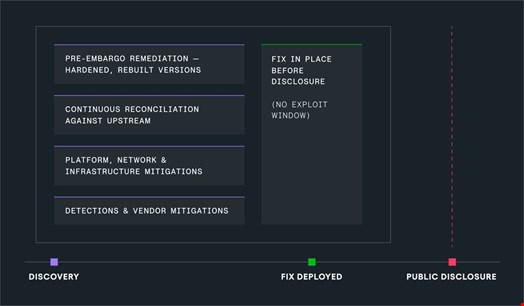
In an early July update, Chainguard’s CEO Lorenc said Athena had already processed over 40,000 vulnerabilities, 42%of which were critical or high severity.
“While significant, the number understates the real exposure, as frontier AI models can chain low and medium-severity bugs into more serious attacks that no single CVSS score captures,” he added.
While the Athena website currently features 19 partners, the page claims “more than two dozen members.”
Akrites: Underlying Vulnerability Hub for Upstream Open-Source Maintainers
Despite being announced slightly later than Lightwell and Athena, Akrites is designed to be the underlying vulnerability pooling hub for upstream open-source project maintainers and centralized findings from a wide range of projects, including Red Hat’s and Chainguard’s.
At launch, the Linux Foundation announced two major missions for its initiative:
- Establish a shared security incident response team (SIRT) for mitigating and remediating vulnerabilities in open-source packages and libraries
- Develop a standardized coordinated vulnerability disclosure (CVD) process, built on confidentiality-first principles and industry-standard tooling
Other partners of Akrites include AI frontier labs Anthropic and OpenAI; cloud and tech giants like AWS, Cisco, Google, Microsoft and its subsidiary GitHub, and NVIDIA; cybersecurity firms like Endor Labs and Zscaler; and large enterprises, such as Citi, JPMorganChase, Ericsson and Vodafone.
Each member of the coalition must donate between one and 10 engineers to the project and pay membership fees based on which of the three membership tiers they chose – Associate, General and Premier –, each corresponding to a level of benefits.
Robinson, who was appointed as CTO of Akrites in June, described Akrites’ sole mission as “coordinating AI-enabled vulnerability reports to upstream open-source maintainers so that the fixes are available to the whole ecosystem.”
"Akrites is a dream that the OpenSSF had five years ago, but it wasn’t a priority. Now it is."
Where Athena and Lightwell are laser-focused on finding vulnerabilities and fixing them – or else deploying workarounds and other mitigation measures – for their customers, Akrites’ SIRT will be tasked with handing over the remediation to upstream maintainers.
It will integrate with external finders such as members of Anthropic's Glasswing project, reporters from MITRE, the Common Vulnerabilities and exposures (CVE) program and the Forum of Incident Response and Security Teams (FIRST), Athena, Lightwell and more.
“One of the requirements to our vulnerability reporters is that, when somebody finds something and wants us to help, they must submit a patch,” Robinson told Infosecurity.
Responding to the deluge of vulnerabilities reported to upstream open-source maintainers, Robinson added, “Just finding the problem is not useful, fixing the problem is what matters.”
He revealed that the initiative’s main platform will be based on Carnegie Mellon University's Vulnerability Information and Coordination Environment (VINCE), a vulnerability management platform developed in 2020 by the Computer Emergency and Response Team Coordination Center (CERT/CC), a unit of the university’s Software Engineering Institute (SEI).
“We have a substantial amount of additional capabilities leveraging large language models (LLMs) to do deduplication, patch creation and more,” added the Akrites CTO, who confessed he’s already received thousands of vulnerability reports after two months of launching the project, an estimated 30% of these are duplicates.
He describes the Akrites workflow as follows:
- Coalition receives intake of vulnerability reports from LLM tools and member organizations
- SIRT prioritizes reports using member-defined issue lists (e.g. reports coming from Lightwell or Athena will take priority)
- SIRT validates proof-of-concept exploits, tests and a suggested fix for each report
- SIRT de-duplicates overlapping reports via model-assisted analysis
- SIRT sets the coordinated disclosure embargo per the upstream project’s policy
- SIRT engineers engage upstream maintainers and submit the patch for review
- Coalition publishes vulnerability details after embargo lifts and patch is accepted
- Coalition measures outcomes and refine automation to improve throughput
“We have geared the system up to be able to take tens of thousands of reports and produce dozens to hundreds of new patches a day,” Robinson noted, estimating the Akrites-run platform will “go live” and “start taking automated vulnerability reports” some time in September.
Down the line, the CTO hopes for a “highly automated and effective system” with “a high degree of accuracy” in validating vulnerability reports and writing fixes. He also said he envisions Akrites to allow for a “smoother path” with pushing these updates to the upstream open-source projects.
Beyond Akrites, Robinson said he is also finalizing work on making available a list of cyber-reasoning systems (CRS) – set of tools used in combination with an AI model to undertake cybersecurity research – developed as part of the AI Cyber Challenge (AIxCC) run between 2023 and 2025 by the US Defense Advanced Research Projects Agency’s (DARPA).
“We will probably offer upstream maintainers to use these tools to find vulnerabilities themselves,” he adds.
Finally, the OpenSSF CTO confided that he has also set himself a personal mission to find people to take over the maintenance of abandoned open-source projects.
“We have between 16% and 40% of open-source projects that are either sunset, abandoned or retired, and yet still in use,” he estimated.
OSERA: Akrites’ Financial Services Arm
Spearheaded by Moderne and piloted by FINOS institutional members, OSERA is a financial sector-focused downstream complement to Akrites.
Current members include Deutsche Bank, Goldman Sachs, Morgan Stanley, Royal Bank of Canada (RBC) and TD Bank Group.
Like Lightwell and Athena, OSERA aims to be a single point of contact of submission for Akrites. Instead of each institution independently identifying, fixing and validating the same issue, the work is coordinated once and made available for all participants to consume.
Here’s what the workflow looks like:
- OSERA members detect vulnerabilities affecting shared open-source dependencies and versions
- OSERA bring firms together to fund and coordinate remediation work once, rather than independently
- OSERA engineers develop fixes in a neutral, openly governed environment like Akrites
- Akrites and OSERA engineers test and validate patches so they are auditable, reliable and portable
- OSERA gives members the tools to rapidly integrate verified patches into their environments
The June OSERA announcement came with preliminary results from a pilot phase. Four critical Java frameworks were successfully backpatched, with widely used, high-risk versions initially released through a member-only repository. Where upstreaming was not viable, public forks are maintained under OSERA governance.
The pilot also validated the end-to-end flow with three member banks, using firms’ existing corporate proxies with no changes to software development tooling.
A shared “Risk Navigator” enabled collective prioritization, supported by common artifact-naming conventions commonly used for vulnerability exploitability exchange (VEX) advisories – a machine-readable security document format that lets software suppliers state whether a known vulnerability actually affects a specific product or component.
The model is designed as a predictable, time-bound platform: backpatches are maintained for 12 or 24 months by vendors with strong upstream credentials, under OSERA-contracted service-level agreements (SLAs).
Open Secure AI Alliance: The Broad AI Security Coalition
Finally, NVIDIA’s Open Secure AI Alliance is the coalition with the largest member pool and broadest scope, but it seems that the framing is not yet as defined as previously mentioned initiatives.
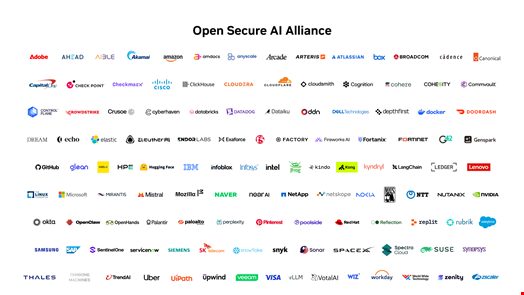
The announcement cited the recent OpenAI/Hugging Face incident as “a clear reminder” that “cyber defenders need open, frontier agentic systems for self-defense.”
Speaking to Infosecurity, Julien Soriano, deputy CISO at NVIDIA, described the coalition as “a movement to develop and share open technologies, techniques and tools to safeguard Alliance software and agents in the age of AI.”
“That includes the broader AI agent stack: models, harnesses, identity, permissions, guardrails, logs, evaluations and runtime controls,” he outlined.
"Many eyes make bugs shallow. Well, now, we also have AI eyes on the code."
While Soriano explains that the coalition is still “in its early days,” he pointed to the Shared AI Findings Exchange (SAFE), a proposed set of guidelines designed to turn agentic cybersecurity incidents into shared protection for the entire ecosystem, developed with the Linux Foundation, as the Alliance’s first accomplishment.
However, members of the coalition still seem to grapple with the end-goal of the Alliance, with OpenSSF’s Robinson admitting he is “still waiting for NVIDIA and my boss Jim Zemlin [CEO of the Linux Foundation] to work that out.”
Future Outlook: How to Measure Success in Open-Source Security
As many of even the most involved stakeholders admitted to Infosecurity, most of these projects are still in their infancy. It is likely too early to assess whether any of them will meet their ambitions, let alone reshape the vulnerability remediation management space enough to keep pace with the explosion of AI-enabled vulnerability reports.
Patrick Garrity, vulnerability researcher at VulnCheck, which has not yet joined any of these initiatives, told Infosecurity that “it's much easier to spin up a community project and promote it than to actually execute CVD at scale.”
“The real proof will be in public evidence of disclosures and how researchers are able to report,” he says.
Robinson is optimistic: “Akrites is a dream that the OpenSSF had five years ago, but it wasn’t a priority. Now it is,” he said, adding that he has been “trying to do something like that my whole career.”
“I feel right now we have the tools, the willpower and access to the technical experts, so I’m very optimistic on our chances that we’re going to be able to provide a very valuable service to the global open-source ecosystem.”
However, Robinson cautioned the industry against repeating the mistakes of the past, “when ‘celebrity’ vulnerabilities like Heartbleed, Shellshock, Spectre and Meltdown, Dirty COW, Sadlock, Log4Shell and XZ Utils created tiny little wake-up calls where everyone got scared, got together and fixed things — and then moved on.”
Equally excited about working on Lightwell, Red Hat’s Duffy welcomed the momentum that these various initiatives create around open-source security.
“I just see every effort as additive. Each actor may bring a different perspective and expertise. The entire community is better for the efforts of various players in the space,” she said.
As for the future of open-source security, particularly impacted by AI capabilities, Duffy thinks it will be better for it – and more secure than proprietary and closed-source software down the line.
“There’s a principle in the open-source world, called Linus’s law [named after Linus Torvalds]: many eyes make bugs shallow. Well, now, we also have AI eyes on the code,” she continues.
“If we find a system that can use these AI finders to fix the bugs in the same volume and cadence, we’ll make open source a better model.”
Image credits: Linux Foundation / FotoField / Shutterstock.com